


Dogs in the Workplace, Part 4
- Feb 5, 2014
- 3 min read
By Jamie Damato Migdal, CEO & Pet Industry Entrepreneur
So now comes the part where I am supposed to tell you about the Best Breeds for the Workplace. Well….it’s not that easy (nothing ever is). Before you take your dog to the office, you should sit down and make a brutally honest list of your dog’s behaviors and idiosyncrasies. You will have to consider not only what your dog will tolerate, but what your coworkers will tolerate as well. If you have a friendly old bulldog who can fall asleep anywhere and not wake up until feeding time, that’s a good candidate for the office. If you have a super-smart and energetic Jack Russell who is capable of doing this, you might not want to leave him cooped up in an office while you are in a four-hour planning meeting. These are some of the more undesirable traits for an office dog:
Territoriality - you don’t want your dog running off everyone who steps over his invisible perimeter line.
Inside voice – you don’t want your dog to announce every distant footfall with endless minutes of shrill yapping.
Incontinence – nobody will thank you for a dog that marks every doorjamb in the building, or lifts his leg on the potted plants in the lobby.
These are some of the behaviors that will make a dog a good candidate for the office:
Sociability – a dog that can greet just about everyone with equanimity is always going to be an office favorite.
Resilience – if your dog can adapt quickly to noises, intrusions, and a parade of different people without getting anxious or fearful, you’ve got a winner.
Quiet, calm behavior – if you have a dog that doesn’t mind being crated or tethered as long as she has a kong or a favorite toy with her, your own work day will be much less anxiety-filled.
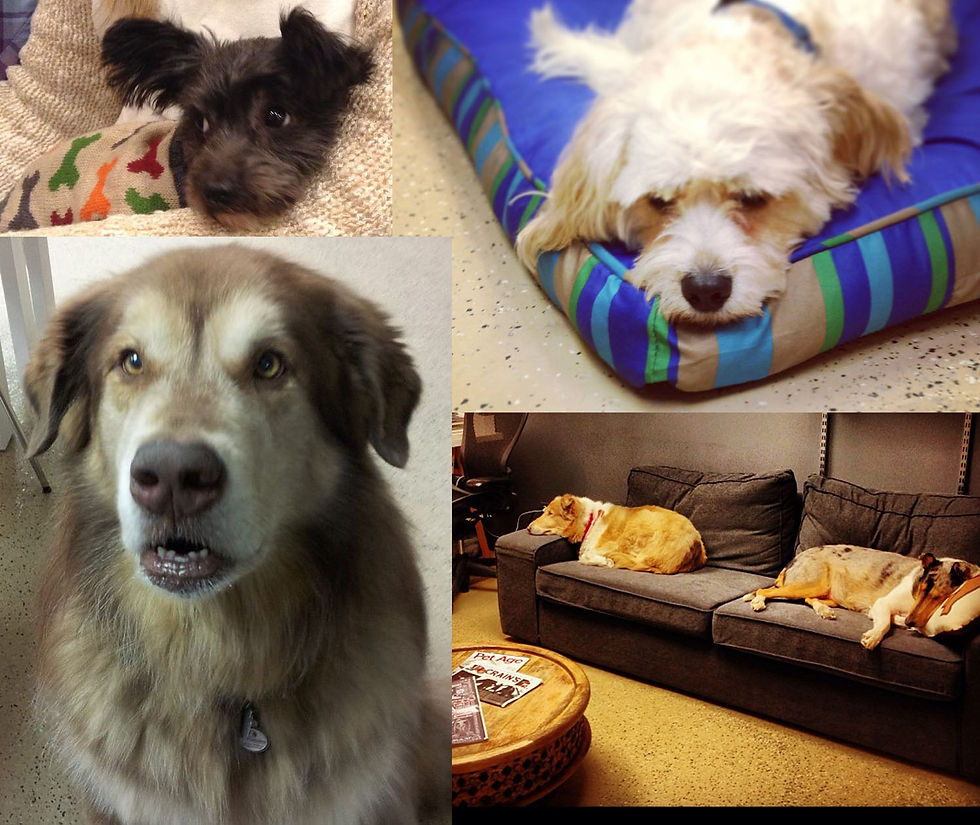
Let’s look at the dogs that we have in the CanineLink office on a regular basis:
Whisper (collie) – she’s calm and relatively sociable, without being demanding. She will bark when she sees strangers in the hallway, but she won’t refuse entry. When she’s had enough, she’ll go into another office and take a nap.
Mimsy (collie) – she’s calm and very sociable, without being pushy. She’ll wander the room and check things out, and has no problem with climbing onto the sofa and sharing space with a relative stranger.
Sitka (Newfie/Malamute) – he’s calm, friendly, and doesn’t mind complete strangers fawning all over him. When he’s had enough socializing, he’ll sack out in another room.
Murray (King Charles Cavalier Spaniel/Bichon Frise – aka Cavachon) – he’s not as calm (or, some would say, nap-prone) as Whisper, Mimsy, and Sitka, but he is extremely friendly and sociable. He’s also a smaller dog, and because of his size his more sociable and enthusiastic nature doesn’t become problematic. When Murray puts his paws on you during a greeting, it’s barely noticeable; if Sitka were to do the same, it would be considerably more daunting.
Hobo (Cairn? Yorkie? Who knows?) – he’s polite to strangers and overall fairly calm and non-reactive. However, he isn’t perfectly housetrained (yet), so he requires more management and clean-up.
On any given day, all of these dogs might be in the CanineLink office at the same time. Although they are all used to each other, everyone is always alert to the need for management or intervention in case something changes. We can put dogs behind closed doors or into crates if necessary, and run them out for a walk if a situation starts to get out of hand. What you can see from the list of our “resident” dogs is that there is no one breed that is necessarily more suitable to an office setting than another. It all depends on the type of office, the tolerance of your co-workers, and how your dog is likely to handle the ever-changing stimuli. And just remember – if you’re ever in doubt about whether or not your dog will be able to handle the office, it’s probably better to leave him at home.
********

Comments